
Import Stacking Rack: Essential Guide for Warehouse Efficiency
2026-10-19
Warehouse managers know the pain of watching valuable floor space disappear under messy pallets. Every square foot counts, yet traditional racking systems often lock you into fixed layouts that can't adapt to changing inventory. Import stacking racks flip that script: they're portable, stackable, and built to turn dead zones into dynamic storage. Whether you're handling seasonal surges or just tired of forklift traffic jams, these racks give you the flexibility to reconfigure on the fly. In this guide, we'll break down how import stacking racks can slash handling time, boost throughput, and make your warehouse breathe again. And if you're ready to see what a well-engineered rack looks like, check out Lanyuda—their lineup is a solid place to start.
Imported Racks That Survive Warehouse Punishment
Warehouse floors chew up cheap racking in months. Imported racks that hold up under that abuse tend to share a few traits: thicker uprights, welded braces instead of flimsy clips, and powder coat that doesn't flake after the first pallet strike. You can spot the difference in the welds—consistent bead width, no undercut, no spatter. That's what separates a rack that's still straight at year three from one that's leaning against a wall.
Load beams get the worst of it. Forklift masts hit them daily. Imported beams designed for punishment use closed-box profiles or reinforced step beams with extra return flanges. They don't twist when a 2,000-pound pallet drops a few inches too hard. If the beam endplate is stamped from heavy gauge steel and the safety lock engages without a hammer, it'll likely outlast the lease.
Don't assume imported means softer steel. Some of the toughest warehouse racking comes from plants running ISO 9001 lines with full traceability on each coil. Ask for a mill test report. A rack that survives punishment isn't about origin—it's about cold-formed, high-yield steel and connection points that don't rely on bolt tension alone. Put a few sample uprights in the worst aisle and watch what happens.
Vertical Storage Without Sacrificing Access
Tall cabinets with pull-out trays turn that awkward gap between appliances into a grab-and-go pantry. Each level slides forward independently, so you can reach a jar at the back without moving anything else.
Wall-mounted racks work the same way: hang pots, cutting boards, and lids on vertical rails, then lift off what you need while the rest stays visible. The trick is keeping each item in its own slot or hook so nothing hides behind another.
For smaller items, use vertical drawer dividers or stepped shelves inside a standard cabinet. Spices, cans, and boxes stay lined up like books on a shelf, and the taller back row remains easy to spot when the front row is short.
Load Limits That Manufacturers Won't Advertise
When you see a tow rating or payload figure on a brochure, it usually comes from a very controlled test: flat ground, cool temperatures, a single driver, and no accessories. Real life rarely looks like that. Add a full tank of fuel, a couple of passengers, some gear in the bed, and a slight uphill grade, and the actual safe load can drop well below the headline number. Manufacturers don't highlight this because the fine print is messy and it makes their trucks look weaker than the competition.
The same applies to equipment like generators, compressors, and even industrial shelving. A "maximum load" on a spec sheet often assumes perfect weight distribution, brand-new components, and intermittent use. Run that piece of equipment near its limit for eight hours a day in a hot environment, and you're asking for premature wear, failed bearings, or a cracked frame. The real-world limit is usually 20 to 30 percent lower if you want it to last. But you won't find that percentage written anywhere in the marketing materials.
Designing Racks Around Real Forklift Paths
Observing real forklift paths often reveals turns that are tighter than manufacturer specs, so rack placement should account for actual swept paths, not just aisle width. Use chalk or tape to trace where operators actually drive during a shift, then design rack rows to match those arcs. This avoids clipped corners and repeated impact damage.
The common mistake is placing racks symmetrically from a blueprint. Real paths shift because operators take shortcuts, avoid dock plates, or swing wide around columns. Instead, start with the path, then place racks around it. Leave more clearance at the exit of narrow aisles, because that's where forklifts accelerate and the rear end swings out.
You can also stagger rack depths near turns to give the counterweight room without shrinking the storage cube. Test with the actual forklift model, loaded and unloaded, at walking speed and normal speed. Mark scrape marks and adjust before bolting anything down. This saves the floor and the rack legs.
Custom Sizes That Erase Wasted Floor Space
Standard furniture dimensions often force a frustrating compromise: you either cram items into a space that’s too tight or leave awkward gaps along walls and corners. Custom sizing flips that equation entirely. By measuring the exact footprint you have—right down to the inch—you can build pieces that slide into place with zero dead zones. That narrow nook beside the fireplace or the shallow alcove under the stairs suddenly becomes useful instead of being a dust trap. The goal isn’t just to fill space, but to make every square foot work as hard as the central layout does.
Think about how many rooms lose usable area to “almost fits.” A bookcase that stops six inches short of the wall, a desk that juts out past the doorway, a console table that leaves a weird sliver between itself and the window. Each gap might seem small, but together they eat into flow and storage. Custom sizes let you reclaim those inches. You’re not adjusting your room to suit a catalog’s standard options—you’re shaping the furniture around the room’s real dimensions, including odd angles, low ceilings, or uneven walls. The result feels less like a showroom setup and more like the space was planned from the start.
The practical upside goes beyond tidiness. When every piece sits flush, cleaning becomes simpler because there are no hidden ledges or unreachable strips of floor. You also gain flexibility in tight quarters—a bathroom vanity built to the exact width between two walls, or a closet organizer that matches the depth of your shelving exactly. These tailored choices reduce the need for extra filler furniture, which often creates clutter rather than solving it. In the end, erasing wasted floor space is less about minimalism and more about precision: building only what the room truly needs, in the exact shape it needs it.
Morning Checks That Keep Racks Standing
Start with the uprights before the first forklift moves. Walk the narrowest aisle and run a flashlight beam up each frame for bowing, paint flaking away from a bent column, or floor anchors that have worked loose overnight. A rack can hide a twist behind pallet loads, so crouch low and sight down the line.
Then move to the beams and decking. Give each beam end a firm upward tug to confirm the safety clip is seated; a beam that lifts even a quarter inch is already carrying load it was never meant to hold. Check wire decking for shifted panels or cracked welds where the bars meet the channel.
Finish with a quick housekeeping pass. Remove stray shrink wrap and broken boards from the base plates, and tag anything that looks suspect before inventory gets moving. These five minutes catch the small distortions that, left alone, become a collapsed bay by noon.
FAQ
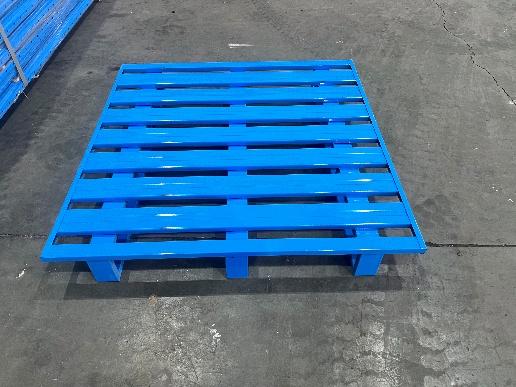
It's a portable stacking frame, usually steel, that holds palletized or loose cargo in vertical layers without needing fixed beams. In a receiving area, these racks let dock workers sort mixed container freight by SKU or destination right at the door, then move the loaded rack with a forklift and stack it two, three, or four high to free up floor space before putaway.
Post-and-base racks handle heavier, uniform pallets and allow four-way fork entry, which speeds up unloading from containers. Wire mesh or corrugated steel containers are better for small, loose items like hardware or textiles because they prevent cartons from falling through gaps. If your imports arrive with mixed carton sizes on the same pallet, a solid steel deck or added plywood base on a post rack usually gives the best stability.
Aim for a dynamic capacity of at least 2,500 pounds per rack when you plan to stack three units high. Ocean freight pallets often weigh 1,800 to 2,200 pounds, and the bottom rack in a stack carries the combined weight of everything above it. Check the static rating separately; some racks are sold with a static capacity that drops sharply once you move them with a forklift.
The biggest damage source is double handling. Stacking racks let you unload once from the container into a rack, then keep the same rack through staging, inspection, and putaway without repalletizing. That reduces crushed cartons from forklift clamps and torn stretch wrap from multiple transfers. Also, the upright posts protect the load when racks are stacked, so top racks don't rest directly on the cartons below.
Forklift operators often push the top rack into position using the mast instead of lifting from the bottom rack's fork pockets. That can bend the corner posts or shear the locking pins. Another issue is stacking racks on uneven concrete near dock levelers; a one-inch slope becomes a serious tipping hazard at four high. Use a spotter and leveling shims whenever you stack more than two units.
Because the racks are mobile, you can move an entire stack to a counting lane without disturbing the load contents. Auditors can scan each rack's location barcode at ground level, then subtract the known tare weight to get net product weight. This avoids breaking down pallets or climbing into deep bays, so a weekly cycle count that used to take six hours often drops below two.
Inspect the locking pins and foot plates every month, especially if racks go outside between container deliveries. Rust on the base is normal, but pitting around weld joints weakens the load path. Replace worn rubber pads on the top corners, straighten bent posts with a hydraulic press rather than hammering, and repaint scratched areas with a zinc-rich primer to slow corrosion from salt air during ocean transit.
Conclusion
Most warehouse managers learn the hard way that import stacking racks are not all built for the daily abuse of real operations. The ones worth buying come from suppliers who design around actual forklift turning radii and operator habits, not just CAD drawings. Vertical storage only pays off when you can still reach every pallet without double handling, so beam spacing and upright depth matter as much as total height. Load ratings are another trap—printed numbers often assume perfectly even weight distribution, which almost never happens with mixed pallets. A rack rated for 2,000 kilos can fail at 1,400 if the load leans or sits off-center. Smart buyers derate by at least twenty percent and watch for subtle signs like beam deflection or floor anchor wear.
Custom sizing is the quiet fix for wasted floor space; off-the-shelf racks leave gaps that add up to hundreds of dead square meters over a year. But custom only works if the frame is still serviceable after installation. That means morning walk-throughs should be non-negotiable: check for bent uprights, missing safety pins, loose baseplates, and any impact marks from recent forklift contact. A single twisted column can turn a four-level system into a collapse risk. The best imported racks combine thick gauge steel, replaceable components, and clear documentation for inspectors. If the manufacturer won't tell you the actual tested failure point or the steel yield strength, walk away. Warehouse efficiency is not about the lowest price per slot; it's about keeping racks standing, loads accessible, and floors clear for years without surprise downtime.
Contact Us
Contact Person: Johnny
Email: [email protected]
Tel/WhatsApp: +86 18151010686
Website: https://lydstorage.com