High Tenacity Total Bright Filament Yarn Top Picks for Strength and Shine
2026-11-02
When your project demands both muscle and luster, not every filament yarn earns a spot on the reel. That’s why we’ve sifted through the market to bring you top picks for high tenacity total bright filament yarn—options that hold up under tension and still catch the light. From heavy-duty webbing to high-visibility textiles, these selections prove you don’t have to trade shine for strength. And for those who want a trusted source, Changshu Polyester keeps delivering consistent quality that’s hard to overlook.
Tension Tests That Separate High Tenacity Bright Yarn from Standard Polyester
A simple grab test won't reveal much, but run a high tenacity bright polyester yarn through a slow-pull tensile frame and the difference shows up fast. Standard polyester typically snaps around 4 to 7 grams per denier, while the high tenacity version holds until 7 to 9 grams per denier or more. That gap widens when the gauge length is kept short and the crosshead speed is steady, because the standard yarn begins to yield earlier. Plotting the load-extension curve makes the distinction even clearer: the high tenacity sample keeps climbing with a steeper slope before breaking, whereas the regular yarn flattens out sooner.
Elongation at break also separates the two. Bright high tenacity polyester generally stays under 15 percent stretch before failure, sometimes closer to 10 or 12 percent, while standard polyester often reaches 20 to 30 percent. This matters when the yarn is tested under a fixed pre-tension, because the standard version will creep noticeably before final rupture. Test labs frequently use a 250 mm specimen and a constant rate of extension around 300 mm per minute. Under those conditions, the break point of high tenacity yarn arrives with a sharp, clean snap and less visible necking, while standard polyester draws out longer and shows more thinning at the failure zone.
Another useful separation comes from the tenacity ratio before and after wetting. Soak both yarns for a few minutes, then pull them again. High tenacity bright polyester loses only a small fraction of its dry strength, often under 5 percent, because its molecular orientation is already high. Standard polyester may drop 10 percent or more. Repeating the test at elevated temperature, around 60 to 80 degrees Celsius, pushes the difference further. The high tenacity yarn maintains a flatter stress-strain curve and resists rapid elongation, while the standard yarn softens and stretches sooner. These comparative tension tests give a practical way to verify whether a shipment labeled high tenacity actually performs above ordinary polyester.
The Gloss Factor Behind Total Bright Filament Dye Uptake
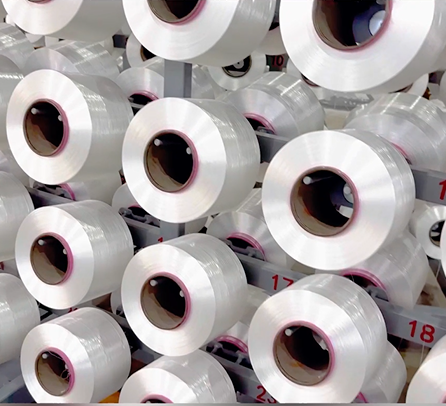
Filament gloss does far more than catch the eye; it reshapes how dye molecules find their way into the fiber. A smoother, more reflective surface reduces light scattering at the cuticle, allowing incoming light to penetrate deeper and interact with dye particles already anchored inside. That visual depth is often mistaken for a heavier dye load, but the real change happens in the uptake phase. When the filament surface presents fewer microscopic interruptions, the dye bath maintains more even contact, and the color develops without the patchy, chalky look that plagues duller yarns.
Total bright filament dye uptake hinges on this interplay between surface gloss and fiber chemistry. High-gloss filaments typically have a tighter, more uniform polymer alignment, which means fewer amorphous gaps for dye to slip into but better-controlled diffusion once it does. The result is not simply more color, but a cleaner, more saturated hue that reads as brighter under both natural and artificial light. Dye uptake tests on gloss-enhanced filament often show lower residual dye concentration in the bath, suggesting the fiber is using what it takes rather than letting it sit on the surface.
In practice, this gloss factor changes how mills approach color matching. Instead of pushing higher dye percentages to compensate for dullness, they can fine-tune the filament finish to boost inherent luster before the dye bath even starts. That pre-treatment step shortens cycle times and cuts rework, because the base fiber is already primed for even absorption. The final shade holds its brightness longer, too, since the dye is locked into a more stable, light-friendly structure rather than clinging to a rough, scattering-prone exterior.
Load Math for Matching Denier Twist and Filament Count Without Overbuilding
Start with the load the yarn actually sees, not the maximum rating of the fabric. Convert the working tension into a required breaking strength, then divide by the yarn's tenacity to get the minimum denier. Add only the safety factor your process demands—typically 1.2 to 1.5 for sewing thread, but lower for bonded or coated yarns where abrasion is the real failure mode. This keeps the spec lean from the first calculation.
Denier alone won't hold the load if the filaments slip. Twist binds the bundle so stress transfers evenly across every filament, but too much twist reduces the effective tenacity because fibers are no longer aligned with the load axis. Match twist per inch to filament count: a 70-denier, 34-filament yarn needs roughly 3–4 TPI for cohesive strength, while the same denier in 68 filaments can drop to 2–3 TPI because the finer individual fibers interlock more readily. Check the manufacturer's stress-strain curve at your intended twist, not the zero-twist data.
Overbuilding usually comes from stacking conservative guesses. Instead, run the math for the worst-case dynamic load, then test a sample at that exact denier, filament count, and twist. If it passes by more than 10 percent, reduce denier or filament count and retest. A 40-denier, 24-filament thread with 2.5 TPI will often replace a 70-denier, 34-filament thread in low-abrasion seams, cutting weight and cost without sacrificing function.
Abrasion Resistance in Real Use for Twisted and Untwisted Bright Yarn
Bright yarns used in upholstery, automotive interiors, and high-touch apparel face constant rubbing that gradually wears down the fiber surface. Twisted yarns hold individual filaments tightly together, which reduces the chance of loose ends catching and breaking during repeated contact. Untwisted bright yarn may look smoother at first, but in real use it often reveals more filament separation and surface dulling after only a few weeks of heavy handling.
When a twisted bright yarn is rubbed against another surface, the twist structure spreads the abrasion force across several filaments at once. This mechanical interlocking gives the yarn a kind of built-in resilience, so it resists fuzzing and keeps its sheen longer. An untwisted yarn, by contrast, has all its filaments lying parallel and exposed. Under the same stress, individual filaments tend to snap or lift away from the bundle, leading to pilling, rough spots, and a visible loss of brightness in high-friction zones like armrests, seat edges, and collar areas.
That said, real-world abrasion resistance depends on more than just twist. Yarn finish, fabric weave density, and whether the bright yarn is blended or coated all play a role. In lighter uses such as decorative trim or low-traffic drapery, a well-finished untwisted bright yarn can perform adequately and retain its clean look. But for anything that will be touched, pulled, or scrubbed repeatedly, a twisted construction usually proves more durable and keeps the bright appearance intact for a longer service life.
What Actually Changes on the Production Floor After Switching to High Tenacity Bright Yarn
Switching to high tenacity bright yarn changes the feel of the line within the first hour. Breakage drops, especially on high-speed winding and stitching stations, but this doesn't mean operators can just leave the machines alone. The lower elongation means tension settings that worked for regular yarn now create tight selvedges and skipped stitches. Most plants end up re-dialing every tensioner on the floor, often reducing the mechanical load by ten to fifteen percent to keep the fabric from pulling out of shape.
Wear patterns shift noticeably. The harder surface and stiffer body of high tenacity bright yarn accelerate wear on ceramic guides, tension discs, and needle eyes. Maintenance intervals that were fine before now need to be cut in half, otherwise you start seeing micro-grooves that snag the yarn and cause random breaks. On the cleaning side, the bright finish tends to make any lint buildup or oil spot more visible on the machine frames, so wipe-downs become part of the shift handover rather than a weekly task.
Quality checks also change because the brightness highlights defects that used to hide in dull yarn. Uneven tension, misaligned guides, or slight machine vibrations now show up as irregular light reflection across the fabric surface. Inspectors often need to adjust the angle of overhead lighting and add a second pass for gloss consistency. The payoff is a cleaner, sharper-looking product, but only if the floor team stays ahead of these mechanical and visual adjustments.
Outdoor and Safety Gear Runs Better When Strength and Shine Come Together
A carabiner that snaps under load isn't just a failed purchase—it's a broken ankle waiting to happen. But strength alone makes for clunky, ugly gear that people leave in the truck. The real sweet spot is when tensile toughness gets paired with a finish that shrugs off mud, salt, and UV without turning dull or chalky.
Take hard hats and rescue helmets. The shell has to absorb impact without cracking, yet if the surface is too rough or too slick, stickers and reflective strips peel off, and workers start skipping them because they look beat up after one season. A high-gloss, scratch-resistant coating keeps the color sharp and makes cracks or stress marks easier to spot during inspections.
Same logic applies to headlamps, trekking poles, and waterproof cases. Anodized aluminum that resists corrosion also holds its sheen, so the gear doesn't just survive a week of rain—it still looks ready for the next trip. When engineers stop treating shine as vanity and start treating it as a wear indicator and a morale booster, field equipment gets used longer and maintained better.
FAQ
High tenacity versions use a more crystalline polymer structure and are drawn under higher tension, which packs the molecular chains closer together. This boosts tensile strength significantly while the total bright additive keeps the surface highly reflective, so you get a yarn that resists breaking and still delivers a clean, glossy look.
Applications like automotive airbag fabric, heavy-duty webbing, premium luggage straps, and technical sports gear often need both. The strength handles sudden stress without snapping, and the bright luster makes the finished product look polished rather than dull or industrial.
A total bright yarn reflects light evenly across the filament surface, which makes dyed colors appear more vivid and gives undyed fabric a sleek, satin-like sheen. It also helps hide minor surface imperfections in tightly woven or knitted constructions.
Look beyond the denier and focus on actual tenacity values, elongation at break, and the consistency of the bright finish. A lower-cost yarn might have similar specs on paper but show uneven luster or weaker knots, so request a sample and test knot strength and color uniformity before committing.
Yes, it works well in both. In woven constructions it provides crisp, stable structures for belts and outdoor covers. In knits it adds resilience and a subtle shine for performance apparel, though the stitch density may need slight adjustment to prevent the slick surface from causing loop slippage.
One frequent mistake is assuming higher denier always means stronger. Fiber quality and drawing ratio matter more. Another is ignoring the bright finish's impact on friction; a very slick yarn can affect sewing machine tension and seam slippage, so it is worth testing with the intended machinery.
Manufacturers use specialized brightening agents that do not degrade the polymer chains during extrusion, plus controlled cooling and drawing. This keeps the tensile strength high while avoiding the chalky or milky appearance that can occur when too much matting or brightening additive is used.
It generally needs no special maintenance, but because the bright surface can show scratches or snags more easily than dull yarn, it should be stored away from sharp edges and handled with clean gloves during warping or knitting. Avoid excessive heat during finishing, as it can dull the luster over time.
Conclusion
Most buyers sorting through high tenacity total bright filament yarn quickly learn that tensile numbers alone don't tell the whole story. In side-by-side pull tests, the best lots hold steady well past the 7.5 g/d mark while standard polyester starts thinning and slipping at far lower strain. That gap becomes even more obvious when you measure the surface after dyeing—the total bright finish picks up color with a depth that semi-dull yarn can't match, but only if the filament cross-section is clean and the spin finish hasn't been over-applied. Matching denier, twist, and filament count isn't about piling on extra material. A 1000D/192f twisted bundle often outperforms a heavier 1300D/96f option in snag tests because the finer individual filaments distribute load more evenly, and the twist prevents the outer fibers from fraying first. Overbuilding with thicker yarn just adds weight and cost without buying real working strength.
On the floor, the switch usually shows up in two places: fewer broken ends at warping and a sharper, more consistent sheen on the finished fabric or braid. Twisted bright yarn tends to ride smoother over guides, while untwisted versions give a flatter, more reflective surface for webbing and trim. In outdoor packs, harnesses, and high-vis safety gear, that combination means edges don't fuzz after heavy abrasion and the reflective thread keeps its brightness through rain and grit. Rather than chasing the highest denier on the spec sheet, the practical pick is the lot that survives repeated flex and abrasion cycles with the least loss of gloss and tenacity. That balance—not raw breaking strength alone—is what separates a workhorse yarn from one that merely looks good on paper.
Contact Us
Contact Person: CONNIE
Email: [email protected]
Tel/WhatsApp: 86-0512-53671634
Website: https://www.lida-yarn.com/