

Food Grade Oil-Free Air Compressor Working Principle Explained
2026-08-15
Every bite of food you take relies on compressed air—for mixing, packaging, even cleaning production lines. But what if that air carries oil? The result could be contamination, recalls, and a broken trust with consumers. That’s why food-grade oil-free air compressors exist, and their working principle is far more clever than simply removing oil. Seize Air engineers have refined this technology to deliver 100% oil-free air without compromise. In this post, we’ll strip away the jargon and show you exactly how these machines keep your process pure—and why the devil is in the design details.
Why Oil-Free Air Is Non-Negotiable in Food Processing
In food processing, even a trace of oil vapor in compressed air can spell disaster. Oil migrates into products, alters flavor profiles, and introduces contaminants that compromise safety. Regulators like the FDA and EU have zero tolerance for such risks, making oil-free air not just a preference but a baseline requirement for compliance and consumer trust.
Beyond the regulatory stick, there's a practical carrot: oil-free compressors remove the need for downstream filtration systems that are costly to maintain and prone to failure. Without oil, you eliminate the risk of filter breakthrough and the expense of condensate treatment. For any facility aiming to avoid recalls or shelf-life surprises, this is the only sensible choice.
Real-world incidents—where a single faulty seal led to oil mist in packaging lines—show how quickly a small oversight becomes a public recall. That kind of damage isn't just financial; it erodes brand equity built over decades. In short, oil-free air is the silent guardian of product integrity, and no serious processor would leave that to chance.
The Dry Compression Cycle: Step-by-Step Without a Single Drop of Oil
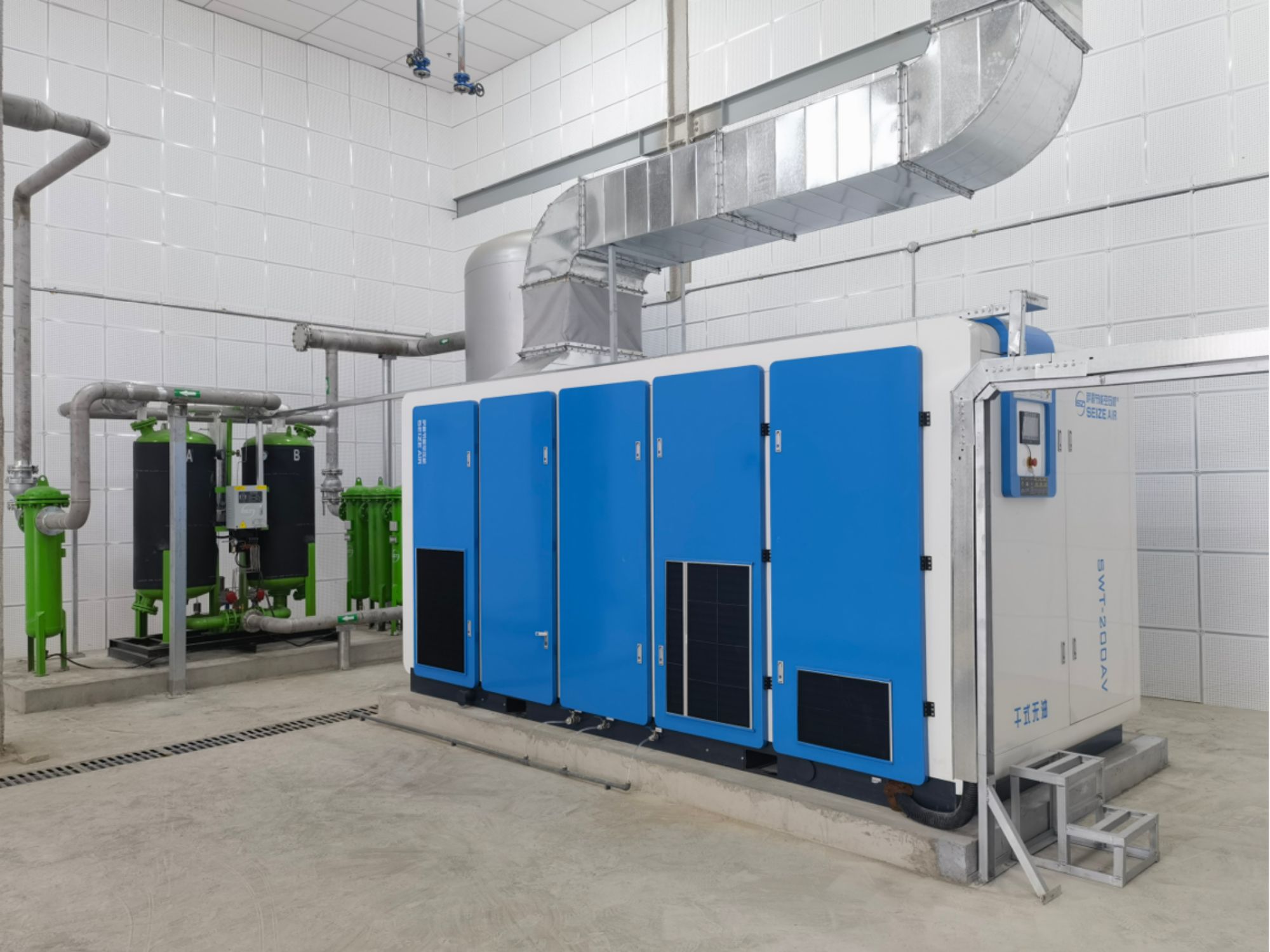
Most people assume compressed air always comes with a fine mist of oil, but dry compression turns that notion on its head. The cycle starts with intake air being drawn through a precision filter that strips out any ambient moisture or particulates. Then, instead of using oil for sealing and cooling, the compressor relies on specially coated rotors and tight clearances that eliminate metal-to-metal contact. This means the air that leaves the compression chamber is already remarkably clean, with no oil carryover to worry about later.
What really sets the dry cycle apart is what happens between the stages. In a multi-stage dry compressor, the air gets a chance to cool down in an intercooler after the first compression. That cooling step is crucial because it lets moisture condense out before the air enters the next stage. By the time the air reaches the final discharge, it has passed through multiple dry stages and aftercoolers, each one improving purity without a single lubricant droplet entering the stream. Some operators are surprised to learn that the compressed air can actually be cleaner than the ambient air it started from.
Maintenance on a dry compression system looks different too. There is no oil to change, no oil filters to swap, and no risk of oil degrading under high heat. Instead, you keep an eye on the air filters and the condition of the dry-running seals. That trade-off appeals to industries like food packaging, pharmaceuticals, and electronics, where even trace oil would ruin a batch. The dry cycle may demand more careful temperature management, but the payoff is a compressed air supply that stays honest from inlet to outlet.
How Specialized Coatings and Seals Replace Lubrication
Dry-running machinery used to mean accelerated wear, heat buildup, and eventual seizure. Specialized coatings flip that assumption by embedding solid lubricants such as molybdenum disulfide, graphite, or PTFE directly into the surface. Instead of relying on a film of oil that can leak, degrade, or get pushed out under extreme pressure, these coatings shear at the microscopic level—sacrificing their outermost layers so the base material stays intact. The result is a low-friction interface that works in vacuum, high temperature, or dusty environments where liquid lubricants would either vaporize or turn into abrasive paste.
Seals take a different route. Rather than reducing friction, they eliminate the need for conventional lubrication by keeping contaminants out and retaining whatever minimal lubricant exists within a component. Advanced lip geometries, spring-energized PTFE jackets, and composite polymer bodies create a barrier that survives aggressive chemicals, high shaft speeds, and wide temperature swings. In many modern designs, the seal itself becomes the sliding partner, with a self-lubricating jacket that means even the seal lip no longer requires external grease. Together, coatings and seals let engineers delete oil reservoirs, pumps, and maintenance intervals from the original design—not just replace them.
Managing Heat Buildup in an Oil-Free Environment
Heat behaves differently when there is no oil to carry it away from moving parts. In conventional systems, lubricating oil doubles as a coolant, absorbing thermal energy and transporting it to a cooler or sump. Remove the oil and you remove that pathway, which means residual heat tends to concentrate at contact points, especially in high-speed or high-load applications. The first step in managing this is to identify where the heat originates: friction between dry surfaces, compression of gases, or external sources like nearby motors. Thermal imaging and embedded sensors can reveal hot spots that would otherwise go unnoticed until failure occurs.
Once the hot spots are mapped, active cooling becomes essential rather than optional. Options include forced air convection, liquid cooling jackets around housings, or thermoelectric modules placed directly at the heat source. For smaller assemblies, heat sinks with high surface-area-to-volume ratios can dissipate enough energy, but they must be matched to the thermal conductivity of the surrounding materials. A common mistake is to treat cooling as an afterthought, bolting on a fan where the airflow path is already blocked by structural ribs. Instead, design the airflow first, then build the mechanical support around it. Periodic thermal cycling tests can validate that temperatures stay within safe limits during both continuous and intermittent operation.
Material selection also plays a decisive role. Polymers and ceramics often have much lower thermal conductivity than metals, so they may act as insulators rather than conductors. In an oil-free environment, consider using thermally conductive fillers in polymer components or specifying high-performance alloys that spread heat quickly. Surface treatments like anodizing or thin diamond-like coatings can improve emissivity and help radiate heat away. Finally, monitor for degradation over time: without oil to flush away wear debris, micro-particles can accumulate and act as thermal barriers, gradually raising local temperatures. A maintenance schedule that includes cleaning and inspection of cooling paths will keep heat buildup from becoming a silent failure mode.
From Compression to Contact: Purification Stages Before Air Reaches Food
Compressed air that eventually touches food starts out anything but clean. It leaves the compressor carrying oil vapor, condensed water, rust particles, and whatever microbes were pulled in from the plant environment. The first purification stage removes the heaviest contamination: aftercoolers and water separators knock out liquid condensate, while a general-purpose filter catches larger solids and oil droplets. This step protects downstream equipment and keeps later filters from clogging prematurely.
From there, drying becomes critical because any moisture left in the lines can turn into liquid when pressure or temperature shifts. Refrigerated or desiccant dryers bring the dew point down to a level that prevents condensation inside the distribution network. Coalescing filters then strip fine oil aerosols down to 0.01 micron, and activated carbon filters remove odor and vapor that can affect taste. Only after these stages does the air reach the final point-of-use filter near the food contact surface, where a sterile-grade membrane may be installed to capture any surviving microorganisms before the air exits the nozzle or valve.
Daily Operating Checks That Keep the Oil-Free Promise Intact
Before the first shift kicks off, spend five minutes watching the condensate drains. A steady trickle of clean water means the moisture separation is doing its job; a sluggish or dry drain hints at blockages that can push moisture downstream and compromise the oil-free air. If you see any milky residue or rainbow sheen in the drain pan, that is an early warning sign of lubricant ingress from a failing seal or an overfilled gearbox vent.
Keep a log of the discharge temperature at the same point every day. Oil-free compressors run hotter by design, but a sudden jump of 10°F or more without a change in ambient conditions often points to a clogged aftercooler or a slipping belt. Catching that early prevents the kind of thermal stress that cracks seals and lets oil migrate into the compression chamber.
Finally, put your nose to work. Walk the air line near the dryer outlet and sniff for any sweet or acrid odor. Oil-free systems should smell like nothing at all—just dry, clean air. If you catch even a faint hydrocarbon whiff, shut down that circuit and check the downstream filters before the promise breaks in front of a customer.
FAQ
Ambient air passes through an inlet filter first, removing dust particles before they reach the air end. Inside a dry screw air end, two rotors spin in opposite directions without touching each other, their timing maintained by a synchronized gear set. Because there is no oil film between the rotors, the surfaces are coated with a low-friction material that prevents wear. Air gets trapped between the rotor lobes and the housing, and as the space shrinks along the rotor profile, the air is compressed. This whole process happens without any liquid oil entering the airstream.
The gears and bearings are located outside the compression chamber and sealed off from the air path. They use food-grade synthetic lubricants, and shaft seals keep that lubricant from migrating into the compressed air. The rotors themselves rely on special coatings and a precisely controlled gap, so metal-to-metal contact is avoided even at high speed.
Filters can reduce oil carryover but they cannot guarantee zero contamination, and a failed or saturated filter can release oil into an entire production batch. Oil-free compression eliminates liquid oil at the source, which is much safer for direct contact surfaces, packaging, and processes where air touches food.
Compressing air raises its temperature sharply. An intercooler removes heat between compression stages to reduce the work needed for the second stage, while an aftercooler cools the final discharge air. This cooling also condenses much of the water vapor, making downstream drying easier. In many food-grade designs the coolers are stainless steel or coated to resist corrosion and avoid releasing particles.
Yes, because oil-free refers only to the compression chamber. The intake air still contains water vapor, microorganisms, and particulates. Most food plants need a refrigerated or desiccant dryer, coalescing filters for water and particles, and sometimes sterile filtration to reach the purity level required for direct food contact.
ISO 8573-1 Class 0 is the strictest rating for oil content, meaning no measurable oil aerosol in the discharge. Many food plants also look for FDA-compliant materials for air-contact surfaces, HACCP-compatible maintenance documentation, and NSF H1 registered lubricants in non-air side components such as the gearbox.
Ask for the actual test data showing ISO 8573-1 Class 0 compliance, review the coating materials used on rotors and the housing, confirm that all seals, hoses, and O-rings are food-safe, and check whether the gearbox lubricant is NSF H1 registered. A genuine manufacturer will provide this documentation without hesitation.
Overlooking intake filter replacement lets dirty air erode rotor coatings and reduce efficiency. Draining condensate infrequently allows moisture to accumulate and supports microbial growth in the system. Using non-food-grade lubricants on fittings or tools during service can also introduce contaminants downstream, so every maintenance step must follow the food safety plan.
Conclusion
In food processing, compressed air routinely touches product surfaces, mixing bowls, and packaging, which makes even trace amounts of compressor oil a serious contamination risk. Oil-free air is therefore not just a preference but a core requirement for food safety compliance. These machines achieve lubrication-free operation through a dry compression cycle that eliminates oil from the compression chamber entirely. Instead of relying on an oil film to seal and cool, dry-running rotary screws or scroll elements use tight clearances and precision engineering. Specialized coatings, such as PTFE or ceramic-based layers on rotors and housings, reduce friction while wear-resistant seals and carbon-fiber composite piston rings keep the air path clean. Without oil to absorb heat, internal temperatures can rise quickly, so oil-free compressors manage heat through oversized cooling fans, intercoolers, and aftercoolers, often using two-stage compression to lower thermal load between stages. This means the machine itself must handle more thermal stress, which is why component materials are chosen for high heat tolerance rather than relying on lubricant as a thermal buffer.
Before compressed air reaches food contact areas, it passes through multiple purification stages designed to remove moisture, particulates, and any potential microbial contamination. Coalescing filters capture water droplets and fine particles, adsorption dryers lower pressure dew point to prevent condensation in downstream piping, and activated carbon filters strip out any residual hydrocarbon vapors that might originate from ambient intake air. Sterile-grade membrane filters can also be installed at the point of use to trap bacteria and other microorganisms. Daily operating checks are equally important to maintain the oil-free promise: operators must inspect condensate drains for proper function, monitor differential pressure across filters, verify dryer performance, and ensure intake filters are clean and dry. Regular leak checks and temperature logging further protect the system from contamination or heat-related failures. Because the oil-free claim depends on the entire compressed air system, from intake to final filter, these daily routines act as a safeguard, ensuring that the air reaching food truly remains free of oil, moisture, and microbial contaminants throughout the production cycle.
Contact Us
Contact Person: Mia
Email: [email protected]
Tel/WhatsApp: +86 19821985894
Website: https://www.seize-air.com