

China Precast Concrete Components Are Redefining Modern Construction Efficiency
2026-11-02
As urban construction accelerates, the demand for faster, smarter, and more reliable building methods has never been higher. Traditional on-site casting often struggles with delays, labor shortages, and inconsistent quality. Enter precast concrete components—a game-changer that is quietly reshaping project timelines and structural performance across the globe. From high-rise residential towers to sprawling industrial parks, factory-made elements are now driving a new wave of efficiency on modern job sites. Among the pioneers leading this shift is GETO, whose innovative formwork and precast solutions are helping contractors reduce waste, speed up assembly, and achieve tighter tolerances than ever before. But what exactly makes China’s precast concrete ecosystem stand out? And why are developers increasingly betting on modular precision over poured-in-place guesswork? In this post, we’ll break down the technology, economics, and real-world impact behind this quiet revolution.
Why Chinese Precast Lines Now Pour a Floor Every 48 Hours
The shift to a 48-hour floor cycle did not come from a single breakthrough. Chinese precast plants eliminated the traditional waiting time around concrete curing. Precise temperature control and early-strength admixtures now bring panels to demolding strength in eight hours instead of a full day. Molds move through the line in continuous rotation rather than sitting idle. On the design side, BIM models drive the concrete spreaders directly, cutting placement error to a few millimetres and removing the need for on-site corrections that used to eat up half a shift.
Standardization plays an equally important role. Wall panels, floor slabs, and stair units are limited to a small set of dimensions, so switching a production line from one component to another takes minutes instead of hours. Delivery trucks run on an hourly schedule and components go from trailer to crane hook without touching the ground. Because the structure arrives nearly finished, wet trades on site shrink dramatically. Mechanical and electrical crews can start on a newly poured floor while the next level is already being assembled above, compressing the whole sequence into a two-day rhythm.
Worker demographics have accelerated this change as well. Younger crews prefer operating automated systems over hand-tying rebar on a muddy deck. Digital tracking tools let a single plant monitor thousands of components per day, and any delay triggers an automatic rescheduling across the line. That operational discipline, more than the equipment itself, is what keeps a Chinese precast line pouring a floor every 48 hours without losing quality or pushing crews beyond a normal shift.
Inside the Factories Where Concrete Cures Without Weather Delays
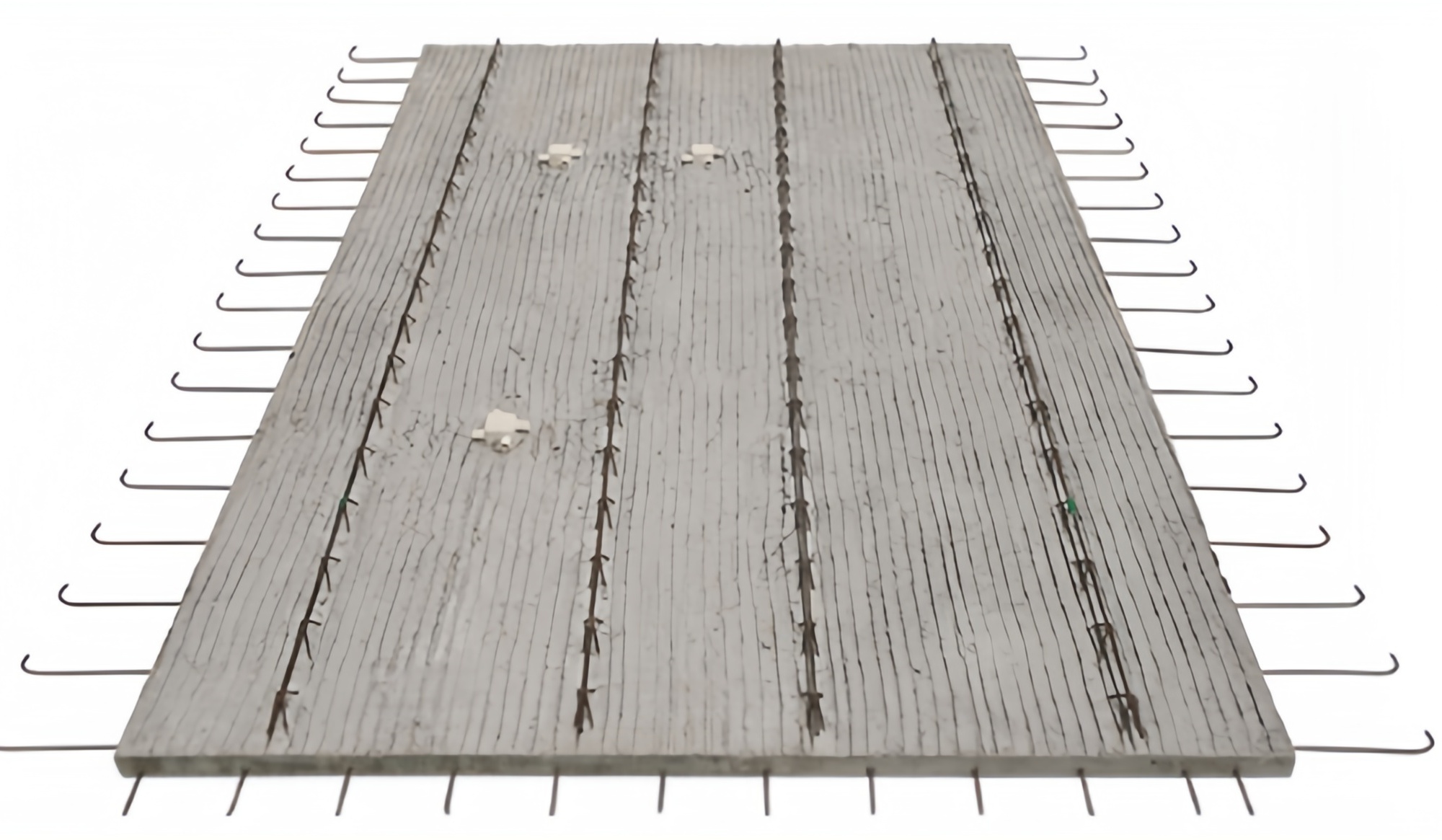
Stepping into one of these plants, the first thing you notice is the absence of open-air curing yards. Instead, massive climate-controlled chambers hum quietly, maintaining exact temperature and humidity levels around the clock. Concrete elements—from hollow-core slabs to precast wall panels—move through these rooms on automated transfer carts, never once exposed to rain, frost, or scorching sun. Workers monitor curing curves from a central control room, adjusting parameters with a few taps. The result is a hydration process that unfolds at a predictable pace, unaffected by whatever storm or heatwave is raging outside.
The secret lies in a combination of insulated enclosures, radiant heating systems, and fine-mist sprayers that keep relative humidity near 95 percent. Unlike traditional methods that rely on tarps and guesswork, these factories use embedded sensors inside the concrete to track internal temperature in real time. If a cold front drops the outside air to minus ten, the interior environment barely flickers. That consistency eliminates the cracking and weak surface zones that commonly plague jobsite curing, giving every batch the same strength profile as the one before it.
For contractors, the payoff is not just better concrete—it's reliable scheduling. A precast element cast on Monday reaches handling strength by Wednesday morning, regardless of the forecast. No more waiting for a three-day rain spell to pass or rushing to tent and heat a pour before the temperature drops overnight. The factory's ability to decouple curing from weather turns concrete from a weather-dependent gamble into an assembly-line certainty, which is precisely why more projects are shifting their production indoors.
The Hidden Cost Logic: Fewer Workers, Tighter Tolerances, Less Waste
Most manufacturing budgets treat labor and material as separate buckets, but the real cost driver is how those buckets interact. When you run with fewer workers, you stop tolerating vague handoffs and start building checks into the process itself. That shift quietly removes the rework loops that never show up on a standard cost sheet.
Tighter tolerances look like an engineering demand, yet they function as a cost filter. A small crew can only hit a tight spec if every step is repeatable. Once repeatability becomes the norm, the need for sorting, re-machining, and extra inspection drops sharply. The savings don't come from paying less per hour; they come from not paying twice for the same part.
Less waste is the trailing indicator of this logic. When fewer people handle a job and the tolerance band stays narrow, you don't generate piles of borderline inventory. You also stop scheduling buffer capacity for inevitable rework. The hidden cost isn't hidden at all—it's just spread across decisions that look unrelated on paper.
How Modular Molds Let One Standard Panel Become a Curved Façade
A standard flat panel usually demands a dedicated mold for every slight change in curvature. Modular molds flip that logic by splitting the forming surface into adjustable segments. Those segments can be repositioned or swapped to create different radii, so one base mold produces multiple curved panels without a full rebuild.
The real trick is the interface between the segments. Instead of a rigid monolithic surface, each module locks into a grid that allows incremental deformation. By tightening or loosening specific joints, fabricators can dial in a smooth arc, then lock everything down before the panel material is formed. This fine control means a single mold kit can handle anything from a gentle wave to a tight corner.
On a real project, that flexibility changes how designers and builders coordinate. The architect can explore facade options without committing to expensive custom tooling, while the fabricator keeps standard panel stock on hand. Curves stop being a premium feature and become just another setting on the mold.
From BIM to Batch Codes: Tracking Every Component to the Minute
A BIM model stops being a static 3D drawing the moment each element carries a live link to its physical counterpart. Every beam, panel, valve, and connector gets a unique identifier in the model, matched one-to-one with a factory batch code. That code travels with the part from production line to pallet to truck, so the model becomes a living record rather than a visual reference. The result is a direct line from the digital object to the exact production run, machine operator, and timestamp of manufacture.
On site, scanning a QR code or RFID tag does more than check a delivery. It logs the moment that component touches the building. The timestamp flows back into the BIM environment, updating the model's status from "fabricated" to "delivered" to "installed" with minute-level precision. If a batch shows a welding defect or a coating issue, the team can isolate every affected part in minutes, not days. The same trace works backward for forensic analysis: a crack discovered during maintenance can be traced to the original batch, the shift that produced it, and the exact hour it left the factory.
This kind of traceability changes how projects handle quality, handover, and long-term operation. Facility managers inherit a model where each component has a verifiable history, including installation sequencing and batch-specific test results. Instead of sorting through paper logs or supplier PDFs, they click on a valve and see its full journey. For owners, that means faster audits, tighter warranty claims, and a data set that remains useful decades after the last crane leaves the site.
What a 30-Story Tower Gains When Its Core Is Precast in a Week
When the core of a 30-story tower is precast and erected in just one week, the entire construction schedule shifts. The core no longer dictates the pace floor by floor; instead, trades can start fitting out lower levels while upper floors are still being assembled. This parallel workflow cuts total project time by several months, which directly lowers financing costs and speeds up revenue generation.
Precasting the core also removes much of the variability that comes with on-site concrete work. Factory conditions allow tighter dimensional control, so elevator shafts and stairwells align more precisely. On site, crews handle fewer formwork cycles, less rebar tying, and almost no wet trades at height—reducing accident risk and inspection delays.
Logistically, the week-long core erection means the tower crane is freed up sooner for cladding and MEP installation. Fewer workers are needed for core construction, which eases site congestion in dense urban areas. While precast elements cost more upfront, the savings from shorter general conditions and earlier occupancy typically outweigh that premium.
FAQ
They are produced in controlled factory environments, which allows for tighter tolerances and less weather-related delays, ultimately speeding up on-site assembly.
Since elements like walls and slabs arrive ready to install, crews can erect a floor in days rather than weeks, cutting construction schedules by up to 30 percent.
A residential tower in Shenzhen used precast staircases and balcony slabs, reducing on-site labor by 40 percent and finishing three months early.
Factory production uses automated batching and curing, so every panel meets uniform strength specifications, which reduces rework and material waste.
Precast plants recycle leftover concrete and use less formwork, which lowers carbon emissions per building by roughly 15 percent compared to cast-in-place.
Some are embedding sensors in panels to monitor curing and structural health, while others use lightweight fiber-reinforced mixes for easier transport.
It shifts work from skilled carpenters on site to factory technicians, easing labor shortages and allowing older workers to stay in the industry longer.
Transportation costs for large panels and the need for heavy cranes still limit use in remote areas, but modular designs are steadily reducing these barriers.
Conclusion
Across China, precast concrete plants have shifted from batch production to a rhythm that feels almost automotive: a full floor slab poured every 48 hours, with curing taking place inside climate-controlled bays where rain, frost, or heat waves no longer dictate the schedule. This alone collapses timelines that used to stretch for weeks. The cost logic runs deeper than speed. With fewer workers on site, tolerances tighten to millimeter-level consistency, and waste drops sharply because molds are reused and excess concrete is recycled back into the mix. What makes the approach stand out is the modular mold system — one standard panel can be reconfigured into a curved façade without retooling the entire line, so architectural variety doesn’t come at the price of production efficiency.
That same discipline extends into digital tracking. Every component carries a BIM-linked batch code, so a beam or wall panel can be traced to the exact hour it was poured, cured, and shipped. On a 30-story tower, the core can be precast in a week and then assembled on site like a vertical kit of parts, cutting crane time and coordination errors. The result is not just a faster building but a tighter one: fewer joints to fail, less material left in the weather, and a construction sequence that feels less like a craft and more like a controlled, repeatable process. China’s precast sector is proving that efficiency is not a trade-off with quality — it is becoming the new baseline.
Contact Us
Contact Person: Quanhui Nian
Email: [email protected]
Tel/WhatsApp: 8618070545691
Website: https://www.getoglobal.com/